How it works
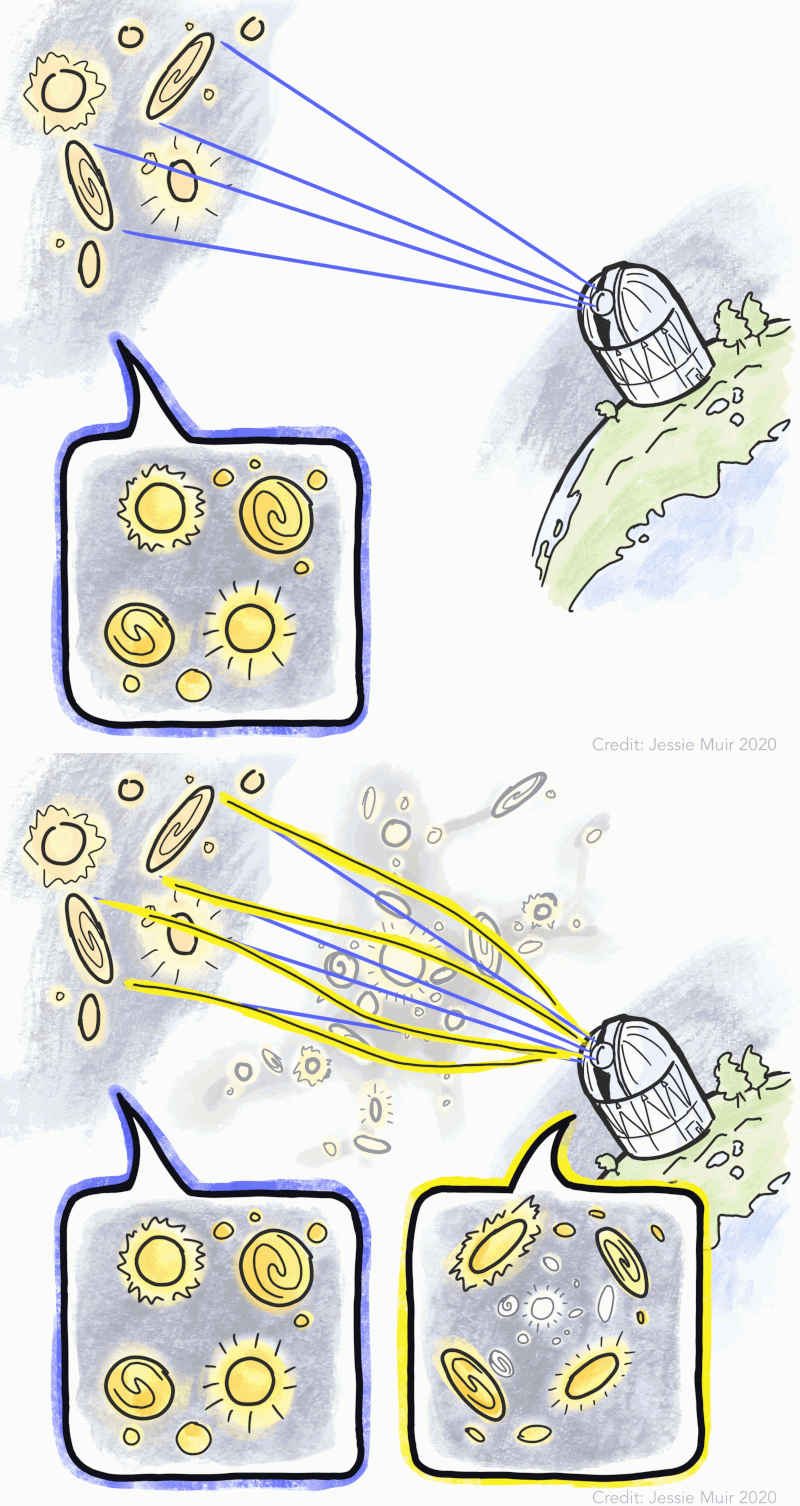
Light from distant background galaxies is deflected by all the mass — dark or luminous — lying between those galaxies and us. The deflection coherently distorts the shapes of background galaxies in the direction of the foreground mass: weak gravitational lensing. Because galaxies are not intrinsically round, the lensing signal is recovered statistically by averaging over millions of galaxy pairs. The result is a direct map of the total matter distribution — including the dark matter that emits no light.
Galaxy–galaxy lensing measures the dark-matter mass around foreground galaxies, by stacking the lensing signal from background sources behind them. Cosmic shear turns the question around: by correlating the shapes of distant background galaxies with each other, we measure the total mass — visible or invisible — sitting in front of them. The statistics of those shape correlations constrain the global amplitude of matter clustering, S8, and the dark-energy equation of state.
Recent results
First cosmic shear results from UNIONS
Our first cosmological constraints from cosmic shear in the Ultraviolet Near-Infrared Optical Northern Survey (UNIONS), based on a galaxy shape catalogue covering ~2,900 sq. deg. of the northern sky. The UNIONS-3500 series presents the shape catalogue, B-mode validation, and 2D cosmological constraints in configuration space (S8 = 0.831+0.067−0.078) and harmonic space (S8 = 0.891+0.057−0.084). Both are consistent with Planck within 1σ.
Filaments of the cosmic web
We produced the first composite image of dark-matter-dominated filaments connecting galaxy halos. Coverage at the University of Waterloo, CBC and Newsweek; journal paper in MNRAS.
Shapes of dark-matter halos
Halos are not spherical: they are elliptical in projection and aligned with the light of the galaxies they host, as we showed in Robison et al. 2023.
Lensing by cosmic voids
Cosmic voids — the vast under-dense regions between filaments and clusters — leave a measurable signature in the shapes of background galaxies. Stacking the weak-lensing signal around many voids probes the behaviour of dark matter and dark energy in low-density environments. See the 2026 MNRAS paper.
Surveys

UNIONS
Lead, weak-lensing team
Ultraviolet Near-Infrared Optical Northern Survey — deep panchromatic imaging of 6,000+ sq. deg. of the northern sky. The first weak-lensing papers are out (ADS library).

Euclid
Co-lead, galaxy–galaxy lensing
ESA space mission, launched 2023; member of the Weak Lensing Science Working Group.

Rubin / LSST DESC
Member, Dark Energy Science Collaboration
The Vera C. Rubin Observatory's Legacy Survey of Space and Time (LSST) will deliver the deepest wide-field weak-lensing dataset of the 2030s; DESC is the LSST cosmology collaboration.