The puzzle
Most of the matter in the universe is invisible. The stars, gas, dust, and planets we can see account for only ~15% of the total matter; the remaining ~85% — dark matter — emits no light, and has so far eluded every direct detection attempt in particle-physics experiments. Its presence is inferred from gravity alone: it bends light, holds galaxies together, and shapes the cosmic web on the largest scales.
The question driving much of modern cosmology is what dark matter is. Is it a new fundamental particle? Does it interact only via gravity? How is it distributed on small scales and on the largest scales? My group attacks these questions through the gravitational lensing of distant background galaxies and the peculiar motions of nearby galaxies.
How we know it's there
- Gravitational lensing. The shapes of background galaxies are subtly distorted by the gravity of foreground mass; the inferred mass dwarfs what we can see directly.
- Large-scale structure and cosmic flows. The clumpy web of galaxies, clusters, and voids — and the peculiar motions of galaxies within it — match predictions from simulations only when dark matter is included.
- Galaxy rotation curves. Stars in the outer regions of spiral galaxies orbit too fast to be held by the gravity of the visible matter alone.
- Galaxy cluster dynamics. Galaxies in clusters move at speeds requiring far more mass than the cluster's visible matter — the original evidence (Zwicky, 1933).
- The cosmic microwave background. The fluctuation spectrum of the CMB encodes the relative amounts of dark matter, baryons, and photons in the early universe.
What my group has done
Understanding dark matter with weak lensing
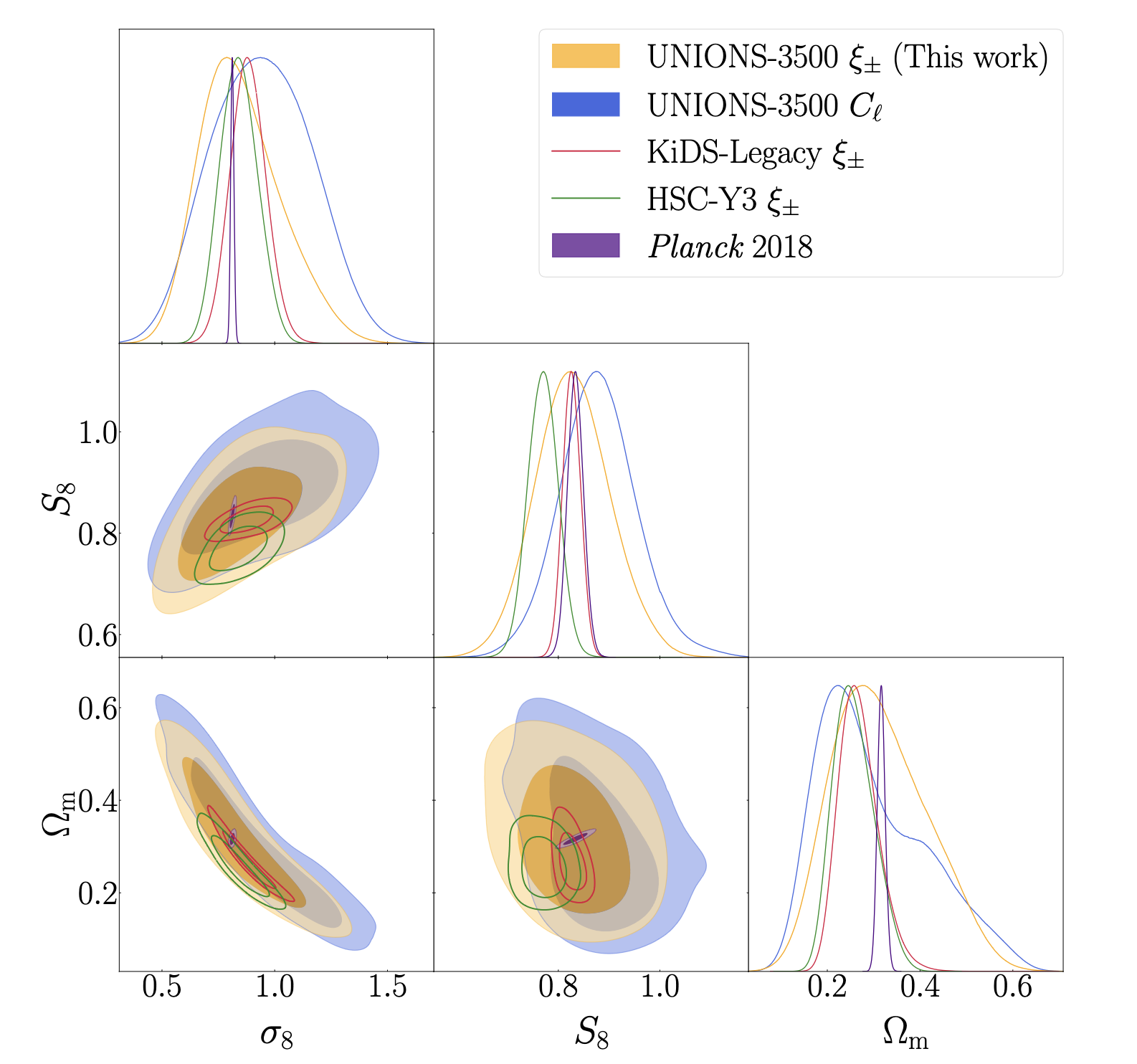
Weak gravitational lensing slightly distorts the shapes of distant background galaxies in the direction of foreground mass. By correlating the shapes of billions of galaxy pairs, we can infer the dark-matter distribution. The first cosmological constraints from cosmic shear in UNIONS, the Ultraviolet Near-Infrared Optical Northern Survey, are now out — see the UNIONS-3500 series.
Large-scale structure and cosmic flows
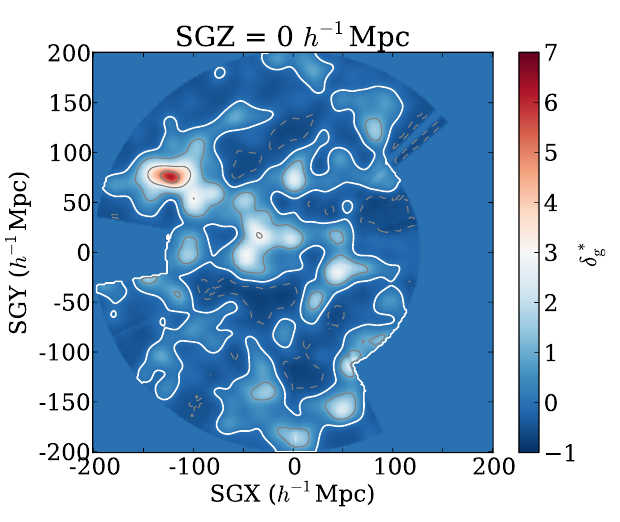
On scales of tens to hundreds of Mpc, galaxies trace the underlying dark-matter density field and move in response to it. The amplitude of the resulting peculiar velocities measures the growth rate of structure, f, times the clustering amplitude, σ8. In Carrick et al. 2015 we compared 2M++ density-field predictions to Tully–Fisher peculiar velocities and obtained fσ8(z ≈ 0) = 0.401 ± 0.024, reproducing the Local Group's motion as a by-product. In Boruah, Hudson & Lavaux 2020 we updated this with a larger SNe Ia sample and obtained fσ8 = 0.400 ± 0.017. See the large-scale structure and cosmic flows page for details.
Mapping the dark-matter cosmic web
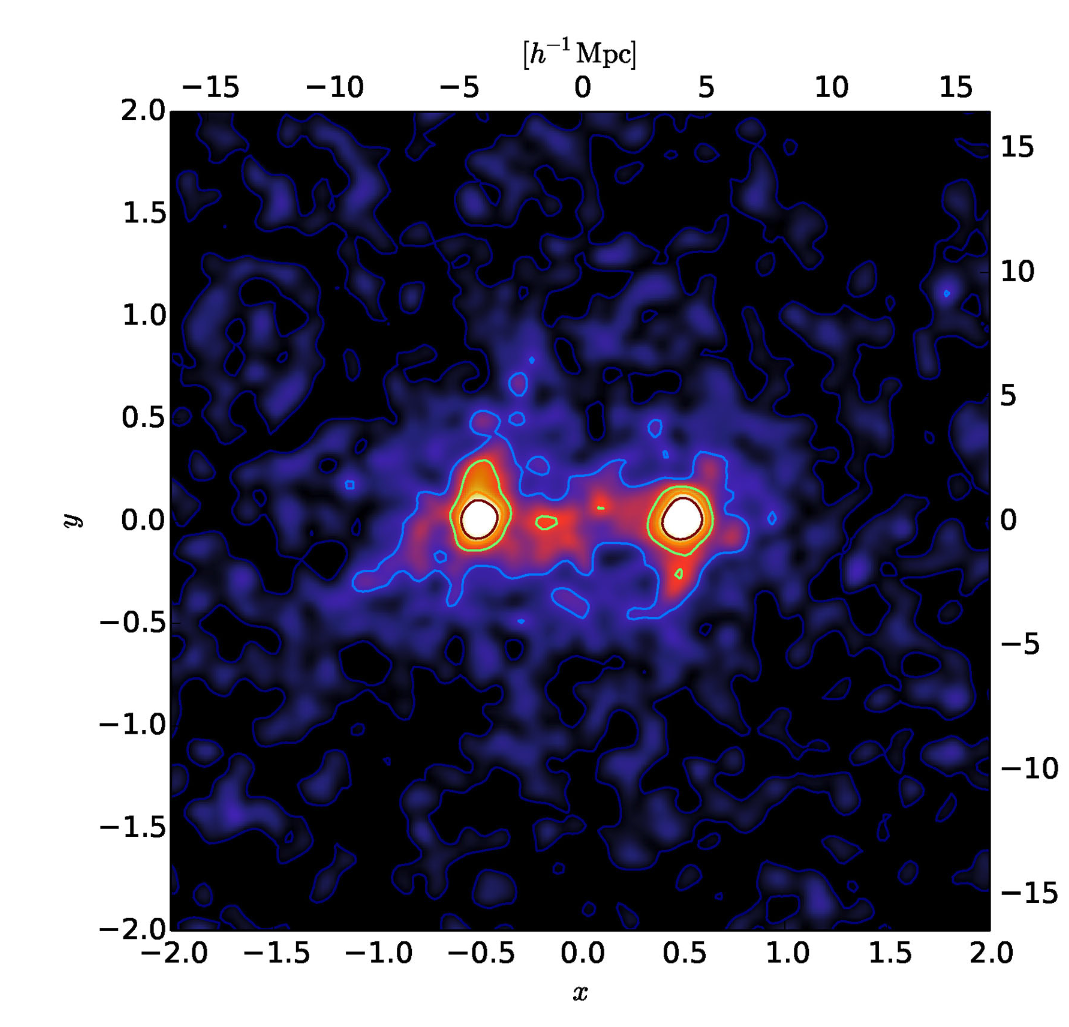
Cosmological simulations predict that galaxies sit at the nodes of a vast filamentary network of dark matter called the "cosmic web." In 2017 we produced the first composite image of these filaments connecting galaxy halos, validated by direct weak-lensing measurement.
The shapes of dark-matter halos
Dark-matter halos are not spherical: they are elliptical in projection and oriented along the major axes of the galaxies they host, as we showed in Robison et al. 2023.
Lensing by cosmic voids
The vast under-dense regions between filaments and clusters leave a measurable signature in background-galaxy shapes. We use this signal to probe the behaviour of dark matter and dark energy in low-density environments — see the 2026 MNRAS paper.
Where we stand: S8 from peculiar velocities and cosmic shear
The amplitude of matter clustering, S8 ≡ σ8(Ωm/0.3)1/2, is a headline parameter of the standard cosmological model. The Planck CMB value, S8 ≈ 0.83, is set at last-scattering and projected forward via ΛCDM. Late-time, low-redshift probes measure S8 directly today, and over the past decade cosmic-shear surveys (KiDS, DES, HSC) and peculiar-velocity surveys have variously preferred values somewhat below Planck — the so-called S8 tension. The picture from my group's measurements is nuanced: the two earlier peculiar-velocity analyses (Carrick 2015, Boruah 2020) sit ~1–2σ below Planck; the bias-corrected reanalysis (Hollinger 2024) deepens this to ~2σ; both UNIONS-3500 cosmic-shear analyses are consistent with Planck within 1σ.
| Probe | Result | S8 | Reference |
|---|---|---|---|
| Peculiar velocities (2M++ & TF) | fσ8 = 0.401 ± 0.024 | 0.762 ± 0.046† | Carrick et al. 2015 |
| Peculiar velocities (SNe Ia) | fσ8 = 0.400 ± 0.017 | 0.776 ± 0.033 | Boruah et al. 2020 |
| Peculiar velocities (2M++ recent, bias-corrected) | fσ8lin = 0.362 ± 0.023 | 0.688 ± 0.044† | Hollinger & Hudson 2024 |
| Cosmic shear (UNIONS-3500, configuration-space 2PCF) | S8 direct | 0.831+0.067−0.078 | Goh et al. 2026 |
| Cosmic shear (UNIONS-3500, harmonic-space pseudo-Cℓ) | S8 direct | 0.891+0.057−0.084 | Guerrini et al. 2026 |
† Peculiar-velocity entries are converted from fσ8 at z ≈ 0 using f = Ωm0.55 and a fiducial Ωm = 0.3. The two UNIONS-3500 results are not independent — both use the same shape catalogue but apply two different two-point statistics (real-space correlation function vs. harmonic-space pseudo-Cℓ); they agree at the 2.2σ level. The next step is tomographic and 3×2pt analyses combining the cosmic-shear signal with galaxy clustering and peculiar velocities.
Open questions
- The S8 tension — real or systematic? Late-time probes (cosmic shear, peculiar velocities, redshift-space distortions) consistently sit ~2–3σ below the Planck CMB extrapolation. UNIONS-3500, KiDS, DES Y3 and HSC Y3 give similar numbers; whether the tension is new physics in the dark sector or a residual systematic in the data is still open.
- Cold, warm, fuzzy or self-interacting? The cold-dark-matter prediction overproduces small-scale substructure (cusps, satellites). Warm or fuzzy DM, self-interacting DM, and baryonic feedback all suppress structure differently. Halo shapes and small-scale lensing power are sensitive discriminants.
- Are dark-matter halos triaxial and aligned with their galaxies? Galaxy–galaxy lensing already shows the projected halo is elliptical and broadly aligned with the central galaxy (Robison et al. 2023); measuring the misalignment distribution is a near-term goal with UNIONS-deep and Euclid.